YOU CAN NEVER BE TOO THIN. UNLESS YOU’RE A PIPE WALL.
Non-Destructive Pipe Wall Thickness Assessment
The amount of old pipe that exists in water systems often dictates how water utilities prioritize their rehabilitation and replacement programs. Seldom are decisions based on actual measurements of the structural condition of pipe, as existing technologies typically require invasive measures that disrupt service and can potentially cause a number of problems such as the introduction of foreign organisms into the water system, loss of tools in the pipe and sediment disturbance that can negatively affect water quality.
Fortunately, Echologics’ non-invasive pipe condition assessment service provides municipalities with an accurate measurement of the remaining wall thickness of selected pipes in their water systems, helping them to efficiently and cost-effectively prioritize repairs and replacement while simultaneously detecting and locating leaks—all without breaking ground or disrupting service.
Echologics condition assessment service directly measures a pipe’s structural thickness, which provides an accurate indication of the pipe’s remaining life. Its core technology uses a proprietary acoustic-based leak detection system and a comprehensive proprietary database to assess the structural condition of selected water pipes of all sizes and materials including:
- Ductile Iron
- Pre-Stressed Concrete Cylinder Pipe (PCCP)
- Plastic
- Asbestos Cement (AC)
- And many more
Key Advantages of Echologics
Pipe Condition Assessment Service
- Completely non-invasive and non-destructive
- Does not disrupt flow or service
- No requirement to close service take-offs
- No need for specialized ports
- 0% probability of:
- foreign organisms being introduced into the pipe
- loss of components in the pipe
- disturbance of sediment in the pipe
- Low cost of implementation
- Can accurately identify large leaks many miles away
Implementing the technology
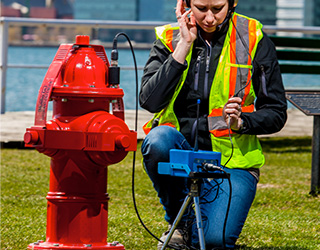
- Pipes are accessed by valves or fire hydrants on the line
- Typical sensor spacing can range from 49’ (15 m) to 984’ (300m). The closer the sensor spacing, the better the resolution to find small areas of degraded pipe
- Acoustic signals can be induced in the pipe by any of several means: by flowing water from fire hydrants, by physically tapping on an appurtenance such as a valve, or by attaching vibro-mechanical shakers to the system
For inquiries, please contact us:
Toll Free: +1 (866) ECHO LOG (324-6564)
Tel: +1 (416) 249-6142
Email: info@echologics.com
-
The Technology
How does this new technology work?
It’s quite innovative. The new technology works by measuring how quickly acoustic signals are transmitted along a section of pipe.
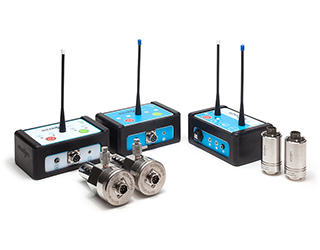
Acoustic signals are induced in pipes by releasing water at fire hydrants in a controlled manner. Then, they are measured using acoustic sensors positioned at two longitudinally separated points on a pipe. The sensors are attached at easy-to-access points, such as fire hydrants and control valves, or directly on pipes in existing access manholes. A schematic of the measurement setup is shown below .
The acoustic propagation velocity is calculated based on the sensor spacing and time delay between the measured acoustic signals. Average wall thickness of the pipe section between the acoustic sensors is then back calculated from this.
-
Testimonials
Echologics has conducted successful pilot studies in diverse environments across North America and the UK. Using our technology, we have provided unrivaled accuracy, even in the most challenging situations. These include:
- City of Hamilton (ON)
- City of Winnipeg (MB)
- Maple Ridge (BC)
- Bristol Water (UK)
- US DOD, Naval Base San Diego
- Las Vegas (NV) Valley Water Department
- Columbus (OH)
- Boston (MA)
“We knew we had issues with some of our AC and CI pipes and we wanted a method to determine which pipes to prioritize for replacement. We already knew where some pipes were degraded, and wanted to see if we could accurately identify them. With Echologics we were able to determine the wall thickness had deteriorated 54.2%. The excavated pipe looked like ‘porridge’! “
“Echologics is pretty much the only game in town in non-intrusive condition assessment.”
Ed Mitchell, Waterworks Superintendent, Maple Ridge (BC)
“We tested two sections of 6” AC pipe and then excavated to confirm the accuracy of our results. Further testing of a 24” AC pipe showed it was in good condition and we were satisfied that Echologics could meet our requirements. Due to our limited water resources, we are very aggressive in water loss management and asset planning. Echologics is a critical partner in helping us to achieve one of the lowest (5%) water loss measures in the country.”
Ryan Benner, Asset Manager, Las Vegas Valley Water Department
“Here in North Bay we have severe soil conditions with hard water and it’s pretty tough on our pipes. We were looking for a way to prioritize the rehabilitation and replacement budget so we conducted a pilot study of ~20 km (12.4 mi) with Echologics Condition Assessment. We had very good success on ductile iron in this study.”
Dominic Schiavone, Water Manager, North Bay (ON)