
Water Pipe Condition Assessment and Leak Monitoring
Learn how ePulse® condition assessment service and EchoShore®‑DX system combine pipe condition assessment with permanent acoustic leak detection to reduce risk and non-revenue water.
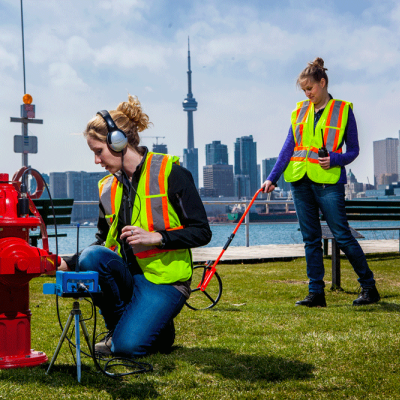
From Snapshot to Always-On: How ePulse® Service and EchoShore®-DX System Work Together to Protect Your Water Network
Water utilities are faced with increasing pressures to meet higher performance expectations while the average age of pipes in their network continues to climb. Often, these demands drive water utilities into reaction mode: responding to leaks when they are reported or become catastrophic and building replacement programs on age or break rate alone. In limited resource environments, it is difficult to get out of the cycle: replacement rates cannot keep up with needs, and reactive leak repair and replacement is costly. Further, background leakage or undetected leaks — leaks that do not surface — go unnoticed until it is too late.
In a world where water is becoming increasingly scarce, reducing water loss means early identification of leakage to enable timely response through monitoring and proactively addressing the root of the problem through replacement. Utilities cannot afford to replace entire networks based on age alone, but they also cannot afford to continue to be surprised by increasing failures. Many utilities have used condition assessment methods or leak monitoring for proactive response to aging inventory in isolation, but the most effective approach is not choosing between condition assessment or permanent monitoring, but using both in sequence.
Echologics designed ePulse® condition assessment service and EchoShore®-DX leak detection system to work together in one Proactive Pipeline Management solution. One provides a measured understanding of pipe condition today to inform a strong replacement strategy for proactive leakage management. The other ensures utilities stay informed as water loss emerges over time. Together, they enable utilities to make informed decisions in both capital and operating budgets to reduce overall NRW.
Part One: Understand Pipe Condition With the ePulse® Service
How It Works
ePulse® service is a non-invasive acoustic pipe condition assessment technology that evaluates the structural health of pressurized water mains without excavation, shutdowns, or customer disruption.
Using acoustic wave velocity, the ePulse® service measures the average remaining wall thickness of a pipe segment. Measured thickness compared to nominal thickness, paired with the ePulse® service’s estimated remaining service life, provides utilities with actionable data to inform repair, replacement, and monitoring decisions.
Since the pipe is assessed for any active leaks on every measurement, the survey is able to provide both accurate condition data and leak pinpointing in the same mobilization.
The ePulse® service is applicable to a wide range of pipe materials, including cast iron, ductile iron, asbestos cement, steel, and PCCP.
What the Results Provide
An ePulse® assessment service delivers data that supports confident capital planning decisions:
- Percentage of wall loss compared to nominal thickness
- Color-coded condition grades that classify structural condition
- Precise leak locations
- Remaining service life estimates when baseline data allows
- GIS-ready outputs that integrate with asset management systems
By leveraging current and accurate condition data, utilities can identify their highest-risk pipes for replacement, take targeted measures to extend the life of in-ground assets, and keep leakage in check.
How It Informs Replacement Strategies to Minimize Leakage
Many utilities discover that pipes scheduled for replacement based solely on age remain in good structural condition. At the same time, other pipes that appear acceptable on paper show significant wall loss. Not only does this mean that good pipes are removed before they need to be, but also that pipes that need replacement the most — pipes that are most likely to leak in the near future — are left in the ground.
By shifting from age-based replacement to condition-based planning, utilities can defer unnecessary capital spending and redirect resources toward higher-risk assets. This approach aligns with industry best practices, such as AWWA M36, and supports defensible, risk-based replacement programs. Replacing the worst-condition pipes is an important mechanism for managing break rates in your network and reducing water loss.
ePulse® condition assessment service answers a critical question: which pipes need attention today?
The Limits of a One-Time Assessment
Pipe condition is not static.
While leaks may be detected during a survey, it is not a replacement for a leakage management program. Leaks identified during an assessment reflect only what exists at that moment. New leaks form continuously across distribution systems. While knowing pipe condition and the ability to focus capital resources on the most critical areas is great for managing critical failure, it is only part of a comprehensive leakage management program.
To manage risk effectively, utilities need visibility into what is happening between assessment cycles. That is where continuous acoustic monitoring becomes essential.
Part Two: Continuous Leak Detection With EchoShore®-DX System
What EchoShore®-DX System Does
The EchoShore®-DX leak detection system is a permanently installed acoustic leak detection system designed for ongoing, system-wide monitoring.
Compact sensors are installed on existing fire hydrants and valves. Each night, during quiet operating hours, sensors record acoustic data that is securely transmitted via cellular networks for analysis.
Advanced algorithms identify acoustic patterns associated with leaks, and Echologics analysts review potential events before alerts are issued. This ensures utilities receive alerts that are most likely to be leaks, reducing false positives and helping field teams focus their time on credible information.
How Alerts Support Operations
EchoShore®-DX system alerts include:
- Confirmation of leak presence
- Estimated leak location
- Historical tracking showing leak progression
- Single sensor and correlation leak detection
- Confirmation after repair
Sensors work as a network, continuously monitoring your system versus isolated moments in time. Alerts are delivered through the Sentryx™ Water Intelligence Platform, by email, or directly into work order systems.
Feedback workflows can enable continuous improvement of both algorithms and analyst inspection on future events, helping reduce the alert load to only what truly needs inspection. Sensors work as a network, monitoring full pipe segments rather than isolated points.
Why Continuous Monitoring Matters
Permanent monitoring allows utilities to detect leaks as they form, often weeks or months before they surface. Early detection reduces water loss, limits infrastructure damage, and lowers emergency repair costs.
Utilities have demonstrated that continuous leak detection can recover millions of gallons per day in lost water, with most leaks repaired before surfacing.
EchoShore®-DX sensors are designed for long-term deployment, with battery life of up to ten years. Sensors can be temporarily removed when hydrants or valves require maintenance and reinstalled without system disruption.
Why the ePulse® Service and EchoShore®-DX System Are Stronger Together
The greatest value comes from pairing condition assessment with permanent monitoring.
Smarter Monitoring Placement
ePulse® service results identify zones with elevated structural risk. Those areas become priorities for EchoShore®-DX system deployment, particularly if replacement or repair budget is not available immediately, ensuring sensors are installed where leaks and failures are most likely.
Alternatively, if the ePulse® service results identify pipes in good condition or risky pipes are replaced, the assessment can inform where monitoring may not be as critical in the short term. The combined solution ensures that condition assessment and monitoring drive the most value to the utility, reduce risk, and improve efficient capital spending. Utilities can phase monitoring installations based on condition data, maximizing return on investment.
Keeping Information Current
EchoShore®-DX system continuously watches for changes between scheduled assessments. If repeated or unusual leak activity appears on a pipe previously rated as low risk, utilities can trigger a targeted ePulse® service reassessment. This creates a closed-loop workflow where monitoring data informs reassessment decisions.
One Partner, One Platform
Both systems use Echologics proprietary acoustic technology, allowing condition data and leak alerts to integrate seamlessly within the Sentryx™ platform. Utilities avoid the complexity of reconciling data from multiple vendors and maintain a unified view of system performance.
Who This Approach Is Designed For
This combined strategy is ideal for utilities:
- Managing aging distribution networks
- Moving from reactive repairs to proactive leakage management
- Reducing non-revenue water and meeting compliance targets
- Operating in environmentally sensitive or high-risk areas
- Justifying capital programs to boards or regulators
From Assessment to Always-On Intelligence
ePulse® service provides a clear, defensible understanding of pipe condition today. EchoShore®-DX system ensures that understanding remains current through continuous monitoring.
Utilities that manage aging infrastructure most effectively are not the ones replacing the most pipe. They are the ones using data to listen intelligently, act early, and invest strategically.
Contact Echologics to design a Proactive Pipeline Management program tailored to your water system.